This guide contains affiliate links. If you buy through them, we earn a commission at no extra cost to you. Prices change often, so always check the current price in the shop. Learn more.
What a portable solar panel is for
A portable solar panel doesn't power your home directly: it plugs into the solar input of a power station and recharges it from the sun. It's what turns a battery that runs flat in a few hours into a system that can get you through a power cut lasting several days.
Unlike roof panels, it isn't connected to the home's wiring, so it's not affected by the anti-islanding protection that switches off self-consumption systems during an outage (we explain it in Do solar panels work during a power cut?). It needs no paperwork either: unfold it on the terrace, balcony or garden and plug it in.
There are three main types:
- Folding with a stand: the most common. They fold like a folder, have legs to angle them towards the sun and fit in a cupboard.
- Flexible: thin and light, designed to be fixed to the roof of a motorhome or campervan.
- Rigid suitcase style: heavier and tougher, less common for home use.
How much energy a panel produces in Spain
A panel's rating (100 W, 200 W…) is what it delivers in ideal lab conditions. In practice, it's best to work it out like this:
Energy per day ≈ panel power × peak sun hours × 0.7
"Peak sun hours" are the equivalent hours of full sun. In much of Spain they're around 5 to 6 on a clear summer day and 2.5 to 3.5 in winter. The 0.7 factor covers losses from orientation, temperature, cables and charging the battery itself.
These are approximate figures for a well-oriented panel with no shade. On cloudy days, output drops sharply. Even so, the key point is this: a single 200 W panel can put back 70 to 85% of a 1 kWh station's energy on a summer day. That's enough to keep the router, lights and phones going indefinitely, and it greatly extends how long the fridge can run if the cut drags on.
How to choose a panel that works with your station
It's the most common mistake: buying a panel that doesn't match the station. Find the solar input section in your station's spec sheet and compare three figures with the panel's:
Voltage range (V)
The panel's open-circuit voltage (Voc) must never exceed the station's maximum voltage. Leave a 10 to 20% margin: panel voltage rises in cold weather.
Maximum current (A)
The panel's current (Imp, or Isc to be on the safe side) must be below what the station accepts.
Maximum power (W)
If you connect more panel power than the station accepts, nothing serious happens, but the excess is wasted. With less, charging is slower.
Connector
Most panels use MC4, and stations usually have XT60, Anderson or DC inputs. Panels often include adapters, but check before you buy.
If you connect several panels:
- In series, voltages add up and current stays the same. It's easy to exceed the station's maximum.
- In parallel, currents add up and voltage stays the same. You need a Y cable (MC4 parallel) and must watch the maximum current.
- Don't mix different panel models in series: the weakest one limits them all.
Examples with real power stations
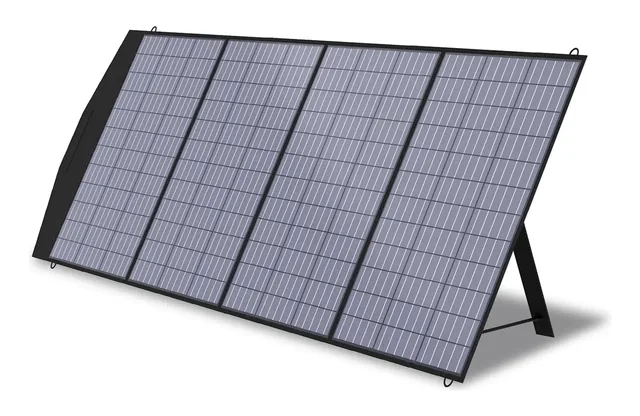
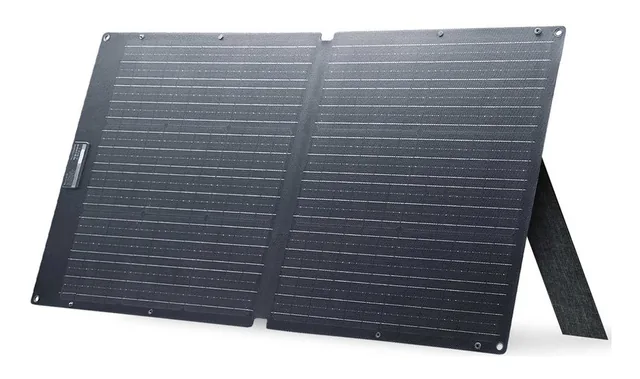
Using the official figures for the ALLPOWERS SP033 panel (200 W, Voc 44.4 V, 5.45 A) and the SOLAX SE100 (100 W, Voc 24.48 V, 4.8 A):
If you have a station from another brand, do the same check with its spec sheet. If in doubt, ask the manufacturer which panels it recommends.
Recommended panels
We've chosen two ALLPOWERS folding panels sold in its official Spanish shop that cover most situations:
See all ALLPOWERS folding solar panels (affiliate link).
Tips for getting the most out of it in a power cut
- Face it south and adjust the angle: about 30° in summer and about 50–60° in winter, steeper the lower the sun.
- Never behind glass: a closed window cuts output a lot. Take it out onto the terrace or balcony.
- Avoid partial shade: the shadow of a railing on a single strip of the panel can cut its total output a lot.
- Move it during the day if you can, following the sun.
- Keep it clean and store it dry: dust reduces output, and connectors should be dry when you plug them in.
- Test it before a power cut: unfold it on an ordinary day and check on the station's display how many watts are coming in.
Frequently asked questions
Can I connect a portable solar panel directly to an appliance?
No. A panel produces direct current at a varying voltage, and appliances need a stable 230 V alternating current. It connects to a power station, which stores the electricity and converts it.
Does a portable solar panel work on cloudy days?
Yes, but it produces much less than in direct sun. On a heavily overcast day, expect only a fraction of its usual output.
How many panels do I need to charge my station in a day?
Divide your station's capacity by the panel's daily output. For example, on a clear summer day a 200 W panel puts back 70 to 85% of a 1,000 Wh station, and two panels in parallel charge it fully, if the station accepts that power.
Can I use one brand's panel with another brand's station?
Yes, as long as the voltage, current and connector are compatible. Check your station's solar input specs and use the right adapter.